What Is AQI?
Aura Air's Air Quality Index (AQI) was developed based on academic research, national AQIs, and other important considerations.
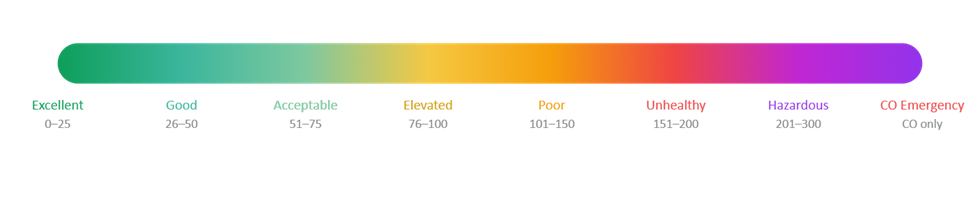
The AQI scale goes from 0 = 'Excellent' to 500 = 'Hazardous' with 8 color-coded categories of equal lengths:
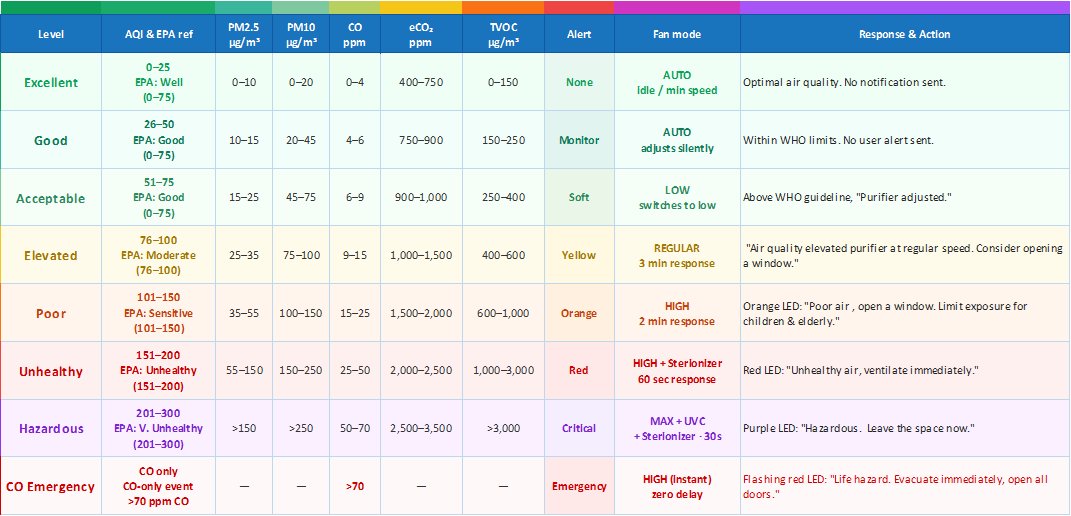
Aura AQI Levels — Thresholds, Alerts & Device Response
What Does the Device Measure?
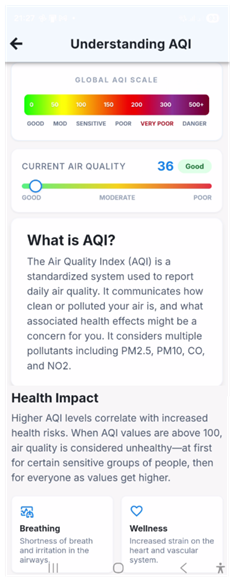
Outdoor AQI
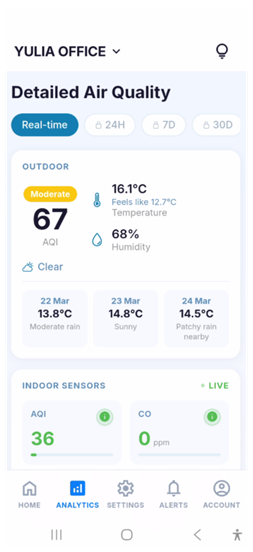
The Outdoor AQI section in your Aura Air app shows real-time air quality data from weather stations near your location. It gives you a quick snapshot of the air quality outside your home or office so you can decide when to open windows, go for a walk, or keep the purifier running.
Outdoor AQI vs. Indoor AQI — What's the Difference?
The Outdoor AQI is sourced from a nearby public weather station, not your Aura device.
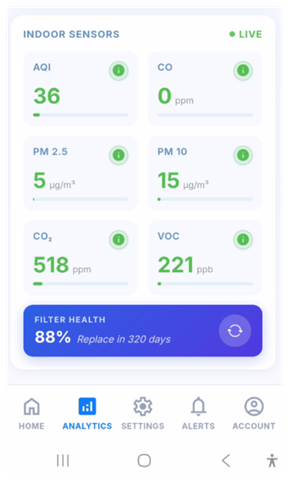
Your Indoor AQI is measured directly by your Aura Air unit in real time.
It is normal for outdoor and indoor AQI values to differ. Your Aura Air purifier actively works to keep your indoor air cleaner than outside, especially during high outdoor pollution events.
Outdoor AQI
Indoor AQI Source
Public weather station near your location
Your Aura Air device
Updates
Every few minutes via the weather API
Continuously — LIVE
Controls
Not controllable
Managed by your Aura purifier
Use
Plan outdoor activities
Monitor your purified air
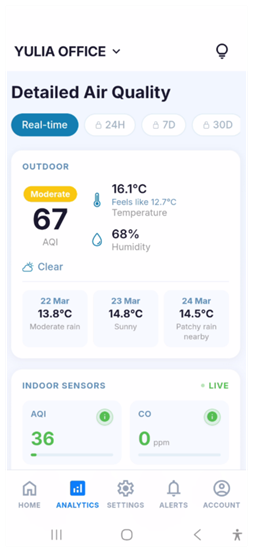
Indoor AQI
CO – Carbon Monoxide
Carbon Monoxide (CO) is a poisonous gas produced from burning fuels such as wood, oil, natural gas, kerosene, coal, and gasoline. Because CO is invisible, odorless, tasteless, and non-irritating, it can cause harm before you are aware of its presence. CO is measured in PPM (parts per million).
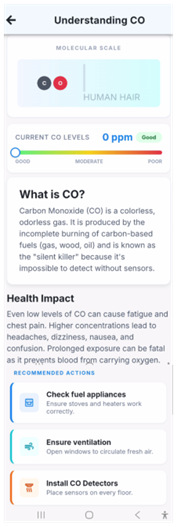
Amount of CO (PPM) | Risk Level | Description |
0–4 | Low (Excellent) | Normal indoor background, no health concern. |
4–9 | Good | Typical range; well-managed appliances. |
9–15 | Acceptable | Elevated; inspect combustion sources. |
15–25 | Poor | High: ventilate immediately; check appliances. |
>25 | Unhealthy–Hazardous | Dangerous: evacuate and call emergency services. |
>70 | CO Emergency | IDLH threshold: life hazard. Evacuate immediately. |
CO₂ – Carbon Dioxide
Carbon dioxide (CO₂) is the gas that people and plants exhale while breathing. Different levels of CO₂ in the air can cause different side effects. Levels are measured in PPM (parts per million).
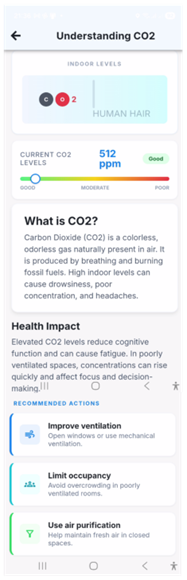
Amount of CO₂ (PPM) | Risk Level | Effects |
400–750 | Excellent | Normal outdoor/indoor levels — WELL Platinum range. |
750–900 | Good | Typical occupied spaces; good ventilation. |
900–1,000 | Acceptable | ASHRAE 62.1 limit; consider improving ventilation. |
1,000–1,500 | Elevated | Drowsiness may begin; increase fresh air. |
1,500–2,000 | Poor | Complaints of drowsiness and nausea; ventilate. |
2,000–2,500 | Unhealthy | Significant impairment; urgently improve ventilation. |
>2,500 | Hazardous | Risk of oxygen deprivation; evacuate if sustained. |
VOCs – Volatile Organic Compounds
Total Volatile Organic Compounds are a large group of chemicals found in many products we use to build and maintain our homes. Once in our homes, they are released or "off-gassed" into the indoor air we breathe. VOC levels are measured in ppb (parts per billion).
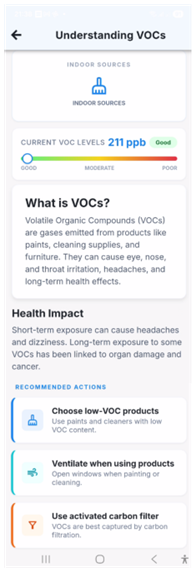
Amount of TVOC (µg/m³) | Risk Level | Recommendation |
0–150 | Excellent | Hygienic levels — EN 16516 compliant. |
150–250 | Good | Acceptable indoor air quality. |
250–400 | Acceptable | Monitor; identify emission sources if persistent. |
400–600 | Elevated | Investigate sources; increase ventilation. |
600–1,000 | Poor | High risk of exposure; ventilate the area immediately. |
1,000–3,000 | Unhealthy | Avoid prolonged exposure; purify air urgently. |
>3,000 | Hazardous | Dangerous levels. Evacuate the space and ensure it is ventilated. |
PM10 – Particulate Matter 10
Particles in the PM10 size range are commonly present in the air and can be drawn into the body with every breath. In the lungs, particles can have a direct physical effect and/or be absorbed into the blood. The recommended normal level of PM10 should not exceed 100 micrograms per cubic meter.
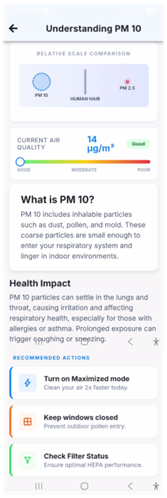
Amount Per m³ | Risk Level | Effects on Environment |
0–55 | Good (0–50) | No impacts. |
56–155 | Moderate (51–100) | Individuals sensitive to NO₂ should consider limiting prolonged outdoor exertion. |
156–255 | Unhealthy for Sensitive Groups (101–150) | Increased likelihood of respiratory symptoms for sensitive groups; children, elderly, and medically affected should limit lengthened outdoor exertion. |
256–355 | Unhealthy (151–200) | Significant increase of respiratory symptoms; sensitive groups, children, and elderly should avoid lengthened outdoor exertion; general public should limit prolonged outdoor exertion. |
356–425 | Very Unhealthy (201–300) | Serious increase of respiratory symptoms; sensitive groups should avoid all outdoor exertion; general public should limit prolonged outdoor exertion. |
426+ | Hazardous (301–500) | Everyone should avoid any outdoor exertion; sensitive groups should remain indoors. |
PM 2.5 – Fine Particulate Matter
Fine particulate matter (PM2.5) is an air pollutant that is a concern for people’s health when levels in the air are high. PM2.5 particles reduce visibility and cause the air to appear hazy when levels are elevated. PM2.5 is measured every 24 hours in micrograms per cubic meter.
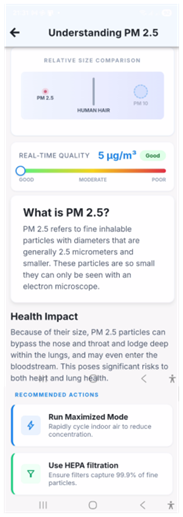
Amount Per m³ | Risk Level | Effects on Environment |
0–12.0 | Good (0–50) | No impacts. |
12.1–35.4 | Moderate (51–100) | Individuals sensitive to NO₂ should consider limiting prolonged outdoor exertion. |
35.5–55.4 | Unhealthy for Sensitive Groups (101–150) | Increased likelihood of respiratory symptoms for sensitive groups; children, elderly, and medically affected should limit lengthened outdoor exertion. |
55.5–150.4 | Unhealthy (151–200) | Significant increase of respiratory symptoms; sensitive groups should avoid lengthened outdoor exertion; general public should limit prolonged outdoor exertion. |
150.5–250.4 | Very Unhealthy (201–300) | Serious increase; sensitive groups should avoid all outdoor exertion; general public should limit prolonged outdoor exertion. |
250.5–500.4 | Hazardous (301–500) | Everyone should avoid any outdoor exertion; sensitive groups should remain indoors. |
Was this article helpful?
That’s Great!
Thank you for your feedback
Sorry! We couldn't be helpful
Thank you for your feedback
Feedback sent
We appreciate your effort and will try to fix the article